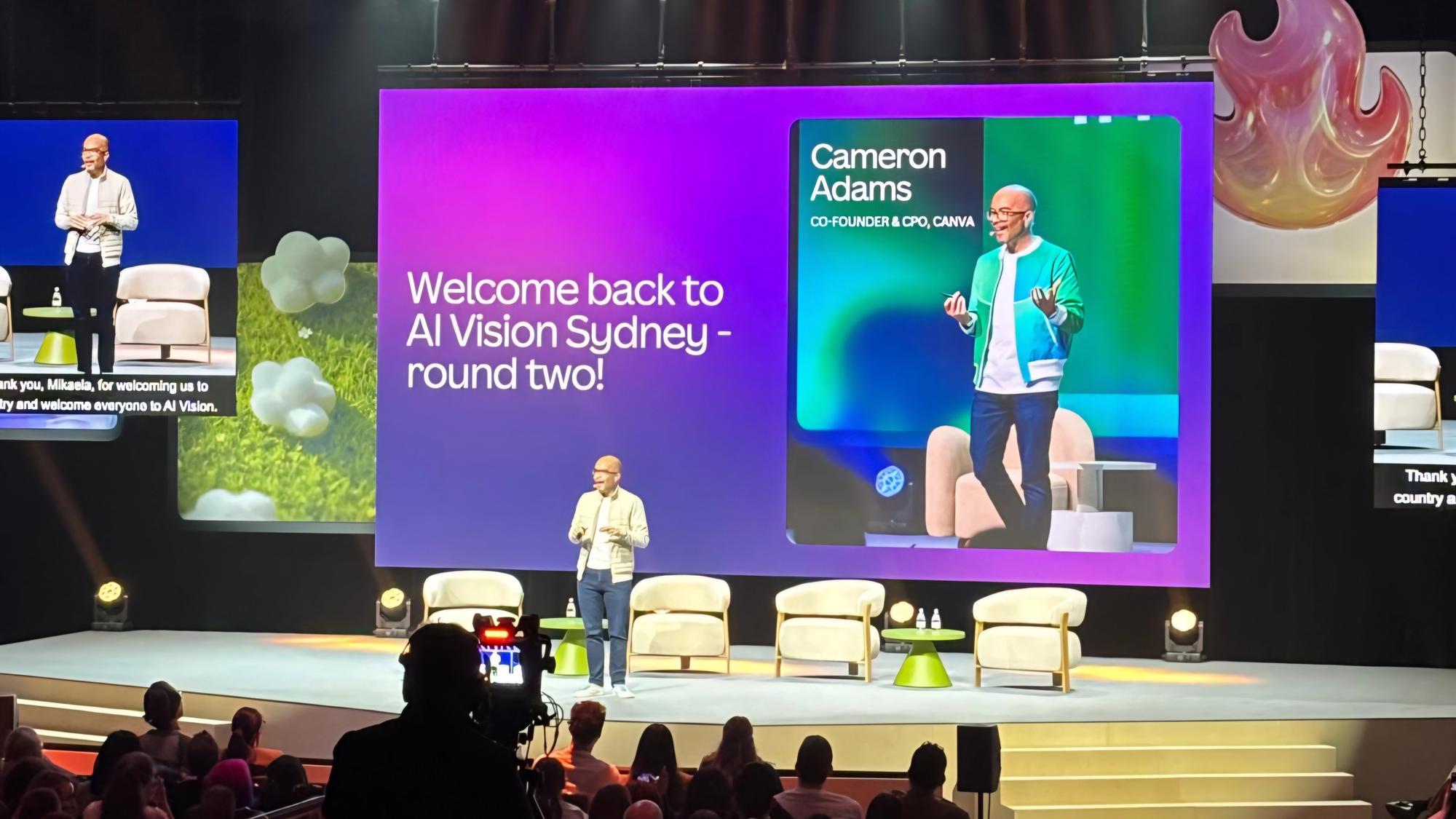
I spent this week at Canva AI Vision in Sydney, listening to some of the people closest to the extraordinary acceleration happening in AI. There was plenty of discussion about what the technology can do. But the ideas I left thinking about weren't really about AI.
They were about what becomes valuable when everyone has access to it.
Alex Neghavi, award-winning Creative Director, put it simply:
"Good got cheap."
That line stuck with me. This is the shift I think a lot of businesses are still underestimating.
AI has dramatically lowered the cost of competence. Anyone can create a good deck. A good campaign. A good strategy. A good image. A good piece of copy. A good first pass at almost anything. Things that once required specialist skills, significant budgets or days of work can increasingly be produced in minutes.
Great right? Or is it?
If everyone can make good, good is no longer an advantage. Suddenly, great gets harder.
The playbook to win is not rare or unique anymore
For years, businesses built competitive advantage around capabilities that were difficult to replicate.
Access to expertise. Production quality. Information. Research. Creative resources. Technical capability.
AI is collapsing many of those barriers.
At the Canva event, the question moved from: How do we use AI to do what we already do faster?
to
What becomes valuable when everyone else can do that too?
Cameron Adams, Canva's co-founder and Chief Product Officer, shared another idea I loved:
"The best tech becomes invisible. You shouldn't know it's there. It should allow you to be more of who you are."
The companies that win today and tomorrow won't be the ones producing the most AI-generated output.
They'll be the ones using AI to amplify something distinctly theirs: their taste, customer understanding, point of view, speed, creativity or ability to see an opportunity before everyone else does.
Technology becomes the infrastructure. Judgment becomes the differentiator.
You can't predict the wave. You can prepare to read it
Next up was Natalie Piucco, Chief Technologist for Applied AI, she offered another useful way of thinking about this moment.
She compared navigating rapid technological change to big-wave surfing.
Her husband, big-wave surfer Dean Bowen, doesn't know exactly what the next wave will look like. No two are identical. What he can do is train relentlessly to understand the conditions. He learns to read the ocean. He understands the undercurrents. He prepares for different scenarios so that when the wave arrives, he can make decisions in real time.
That is a powerful model for business right now.
Too many companies are trying to predict exactly where AI will land.
What model will win?
What job will disappear?
What platform should we invest in?
What will our industry look like in five years?
We probably can't answer those questions with certainty.
But we can build organisations that are better at reading the undercurrents.
Natalie talked about creating deliberate structures for this.
One was particularly interesting: give risk-taking somewhere to live.
At Google, experimentation and failure aren't simply tolerated. There is deliberate capacity for them. A "risk and failure budget" creates permission to test ideas, learn what doesn't work and build organisational muscle before the stakes become existential. That matters because innovation rarely survives when every experiment has to justify itself through immediate ROI.
Place three different kinds of bets
Another framework Natalie shared was thinking about innovation across three horizons: Versioning, Visioning and Venturing.
Tesla is an easy way to understand the distinction.
Versioning is improving what already exists. The Model Y gets updated. Features change. Technology improves. Customer behaviour provides signals about what should come next.
This is where most businesses are comfortable. It is incremental innovation tied closely to today's customer and today's revenue.
Visioning asks what else the company could create. Tesla's Cybertruck was a different proposition, aimed at creating something new rather than simply improving the existing vehicle range.
This requires a bigger leap. New audiences. New behaviours. New assumptions.
Then there is Venturing. These are the enormous bets. The ideas that may sit well outside the existing product pipeline but still connect to the company's deeper capabilities or mission.
For Elon Musk's broader ecosystem, SpaceX is an extreme example of that kind of thinking.
Most companies don't need to start a space company.
But they probably do need to ask whether their innovation portfolio contains enough difference between making today's business better, building tomorrow's business and exploring what could come after that.
Because those are very different jobs, and they require different expectations around risk, investment and return.
The companies that win won't necessarily predict AI best
This was probably my biggest takeaway from Canva AI Vision. We are spending enormous amounts of time trying to understand where AI is going. But prediction alone isn't a strategy.
The better question might be:
Are we building a company capable of responding when the next wave arrives?
Do we have people actively looking for weak signals?
Do we have somewhere safe to experiment?
Are we placing bets beyond incremental improvements to today's products?
Do our teams have enough exposure to emerging technology to recognise an opportunity when it appears?
And perhaps most importantly: if "good" is rapidly becoming abundant, do we know what makes us meaningfully different?
At One03, we spend a lot of time thinking about growth as finding the next source of commercial advantage.
Increasingly, I think that means helping companies build the capability to see around corners, not because anyone can perfectly predict what's coming, but because they have trained themselves to recognise the undercurrents earlier.
Every company needs a lighthouse.
Someone, or a group of people, scanning beyond the immediate horizon, translating what is changing into what it means commercially, and helping the business decide where to place its bets.
The wave is coming either way.
The advantage belongs to the companies that have learned how to read it.